
News

News
News
Mechanical Presses for Electronic Connectors | Selection & Application Guide
Electronic connectors may be small, but they play a critical role in the reliability of power and signal transmission. As products become smaller, denser and faster, stamping is no longer simply about running at high speed. The real challenge is maintaining consistent dimensions, flatness and forming quality throughout high-volume production.
Stamping press selection therefore should not be based on speed, tonnage or static accuracy alone. Product geometry, material, die design, frame rigidity, bottom-dead-center stability, thermal behavior and peripheral equipment all need to be evaluated as one production system.
This guide focuses on a practical way to think about stamping press selection: start with what the part and process require, then define what the machine must control. Risks that are overlooked at the selection stage often reappear later as quality variation, premature die wear or unplanned downtime.
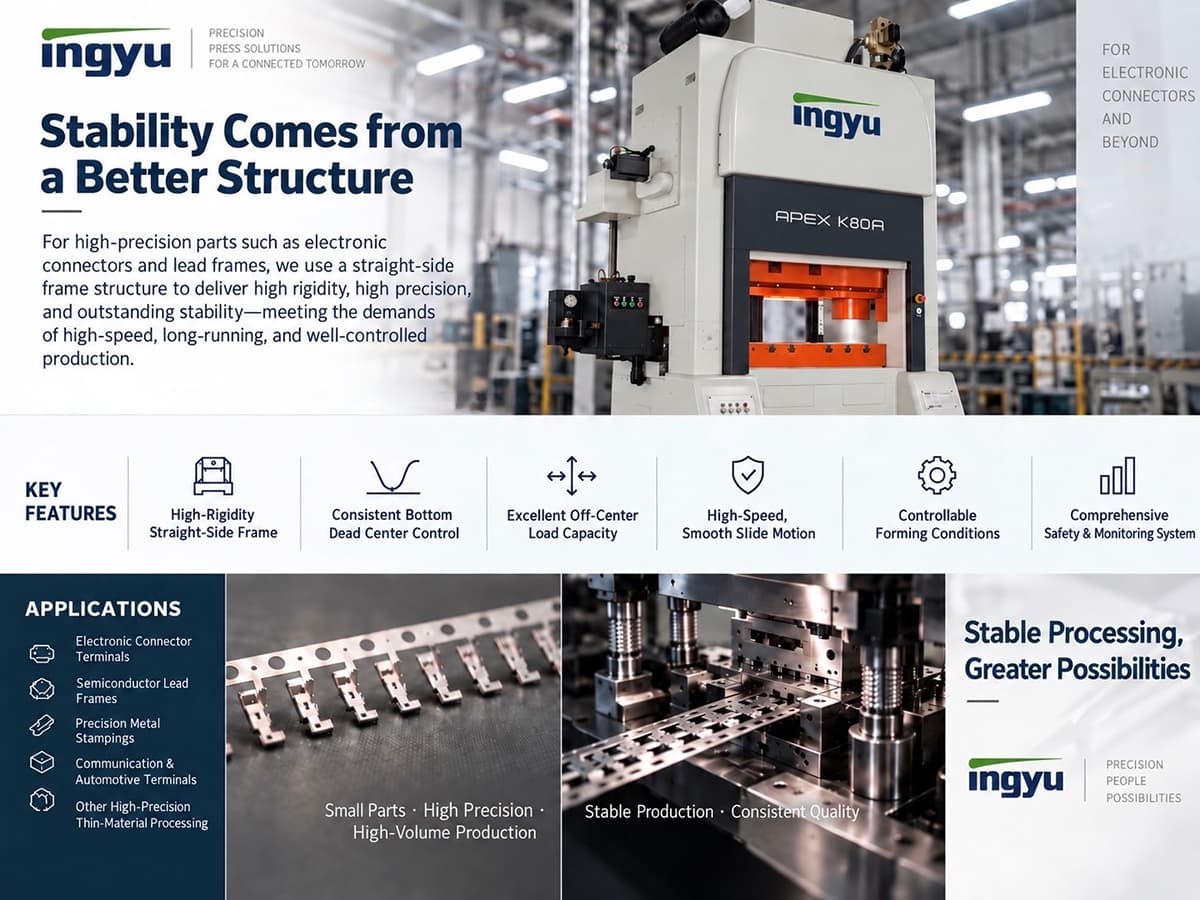
High-precision mechanical presses for high-speed blanking, bending and forming. The objective is not simply higher speed, but stable part dimensions and forming quality over continuous production.
Consumer-electronics terminals, automotive connectors, semiconductor lead frames, and precision contacts for communication and data transmission.
Production speed, press frame rigidity, bottom-dead-center stability, eccentric-load capability, thermal displacement control, and synchronization with feeding and peripheral equipment should be evaluated together.
Achieve the required output while reducing dimensional drift, burr variation, die-related problems and unplanned stops, so that the process remains repeatable.
What Is a Mechanical Press for Electronic Connectors?
It is a precision metal-forming press designed for thin materials, small features and continuous high-speed production.
For connector stamping, consistency from stroke to stroke matters. Changes in speed, temperature, loading or eccentric force can quickly show up as dimensional variation, burrs, flatness problems or reduced die life.
The core requirement is therefore not speed or accuracy in isolation, but the ability to maintain a repeatable and controllable forming condition at production speed.
Typical Applications
Used in board-level connectors and interface contacts for smartphones, tablets and notebook computers. These parts are small and often stamped from thin material, so dimensional consistency and burr control matter as much as production speed.
Includes terminals used in sensors, infotainment systems and battery-management systems. In addition to dimensional accuracy, these parts must support long-term reliability under temperature change and vibration, making process consistency especially important.
Lead frames support the chip and provide electrical connection. Flatness, material distortion and cut-edge quality are critical, and stable press-and-die behavior helps protect downstream packaging performance.
Used in servers, data centers and industrial communication equipment. These applications place additional emphasis on consistent contact geometry, formed features and surface condition.
Press Frame and Drive Configurations
| Structure / Mechanism | Characteristics and Typical Use |
|---|---|
| Frame Structure Straight-side frame |
A closed-frame structure provides higher overall rigidity and better control under demanding loading conditions. It is generally preferred for long progressive dies, thin materials and applications where dimensional stability is critical. |
| Frame Structure Gap-frame / C-frame |
The three-sided open structure provides easy access for die changes, setup and maintenance. It is well suited to smaller dies, fewer die stations, or applications where the load is relatively concentrated. |
| Drive Mechanism Crank drive |
The crank mechanism is the most common mechanical-press drive. It is direct and efficient, with a fixed relationship between crank angle and slide motion. It is highly practical for blanking, piercing and straightforward bending operations. |
| Drive Mechanism Link / knuckle drive |
Its advantage is not simply “higher precision.” The slide slows as it approaches bottom dead center, creating a different velocity profile and longer effective forming time. This can be useful for coining, flattening and more complex forming operations where lower contact speed is beneficial. |
Key Indicators for Stable Production
Slide parallelism and squareness
For thin stock and small terminals, static accuracy is only part of the picture. The slide must remain stable under actual forming load. Tilt or lateral movement can change die clearance and directly affect dimensions, burr condition and die life.
Strokes per minute (SPM)
Speed has a direct effect on output, but it cannot be evaluated by itself. As SPM increases, feeding, die dynamics, lubrication, vibration and thermal behavior all become more demanding. The meaningful question is not “How fast can the press run?” but “Can it remain stable at the speed the part actually requires?”
Thermal displacement and bottom-dead-center stability
During continuous high-speed operation, temperatures in bearings, guides, drive components and the frame gradually change. Thermal expansion can shift the bottom-dead-center position. For precision terminals, the important issue is not a single cold-machine reading, but whether the process remains controlled as the press moves from cold start toward thermal equilibrium.
Vibration and dynamic balance
High-speed stamping creates dynamic forces that affect the press, die and feed system. Good machine balance and frame design reduce unnecessary vibration, limit additional loading on the die and help maintain a more stable production condition.
Production Requirements for Consumer and Automotive Electronics
Connector terminals are often plated, welded or assembled after stamping. Lubricant carryover, leakage and process residue therefore need to be controlled. Lubrication recovery and leak-prevention design can have a direct effect on downstream process stability.
For automotive and other high-reliability applications, a conforming part is only part of the requirement. The process itself increasingly needs to be recorded and traceable. The ability to retain key settings, alarm history and production data supports process analysis, quality management and customer audits.
Small terminals are sensitive to burr height, cut-edge condition and dimensional consistency. Excessive burrs can affect plating, assembly, contact reliability and clearance. Burr control therefore depends not only on the die, but also on dynamic slide parallelism, bottom-dead-center behavior, die clearance and material condition.
High speed is not the same as stable production. If the press structure is not sufficiently rigid, higher speed can amplify vibration and load-related movement, affecting slide parallelism, bottom-dead-center stability, part dimensions, burr condition and die life.
Two presses with the same rated tonnage can behave very differently because crank and link mechanisms have different motion characteristics. Complex bending, flattening, coining or forming operations may require a specific velocity profile or forming time near bottom dead center. Tonnage alone does not define the right press.
As the press operates for several hours, machine temperature changes. Thermal expansion in the frame, guides and drive system can shift bottom dead center and part dimensions. Stability should therefore be evaluated from cold start through warm-up and steady production, not at a single point in time.
Progressive dies do not always distribute load evenly. Longer dies, additional stations or heavy forming concentrated on one side can create eccentric load, causing slide tilt and die-clearance variation. Press selection should therefore consider total die load, load position and the machine’s allowable eccentric-load capacity, with additional tonnage margin where appropriate.
High-speed stamping is a complete system. Feeding, straightening, material lubrication and abnormal-condition detection must operate reliably at the target SPM. A high-speed press cannot create stable output if the surrounding equipment is not equally capable.
A: Electronic connectors are commonly produced with high-speed progressive dies. As die length, station count and forming complexity increase, load distribution and eccentric loading become more difficult to control. A straight-side frame offers higher overall rigidity and better resistance to off-center loading, helping maintain slide parallelism, die clearance and long-run stability.
A: Not necessarily. Link and knuckle mechanisms provide a different slide-velocity profile near bottom dead center and can be advantageous for flattening, coining or operations that benefit from longer forming time. The correct choice still depends on the part, material, die layout, load distribution and production speed. For processes dominated by high-speed blanking, a crank-drive press may be the better solution.
Press Selection Checklist
Selecting a mechanical press for electronic-connector production is not simply a comparison of speed, tonnage and catalog specifications. The real question is whether the press, die and peripheral equipment can remain stable together under actual production conditions.
A good selection is one that consistently produces the required part at the required speed and load, while reducing the risk of premature die wear, unplanned downtime and quality variation.