
News

News
News
High-Speed Stamping Presses: When Do You Need One?
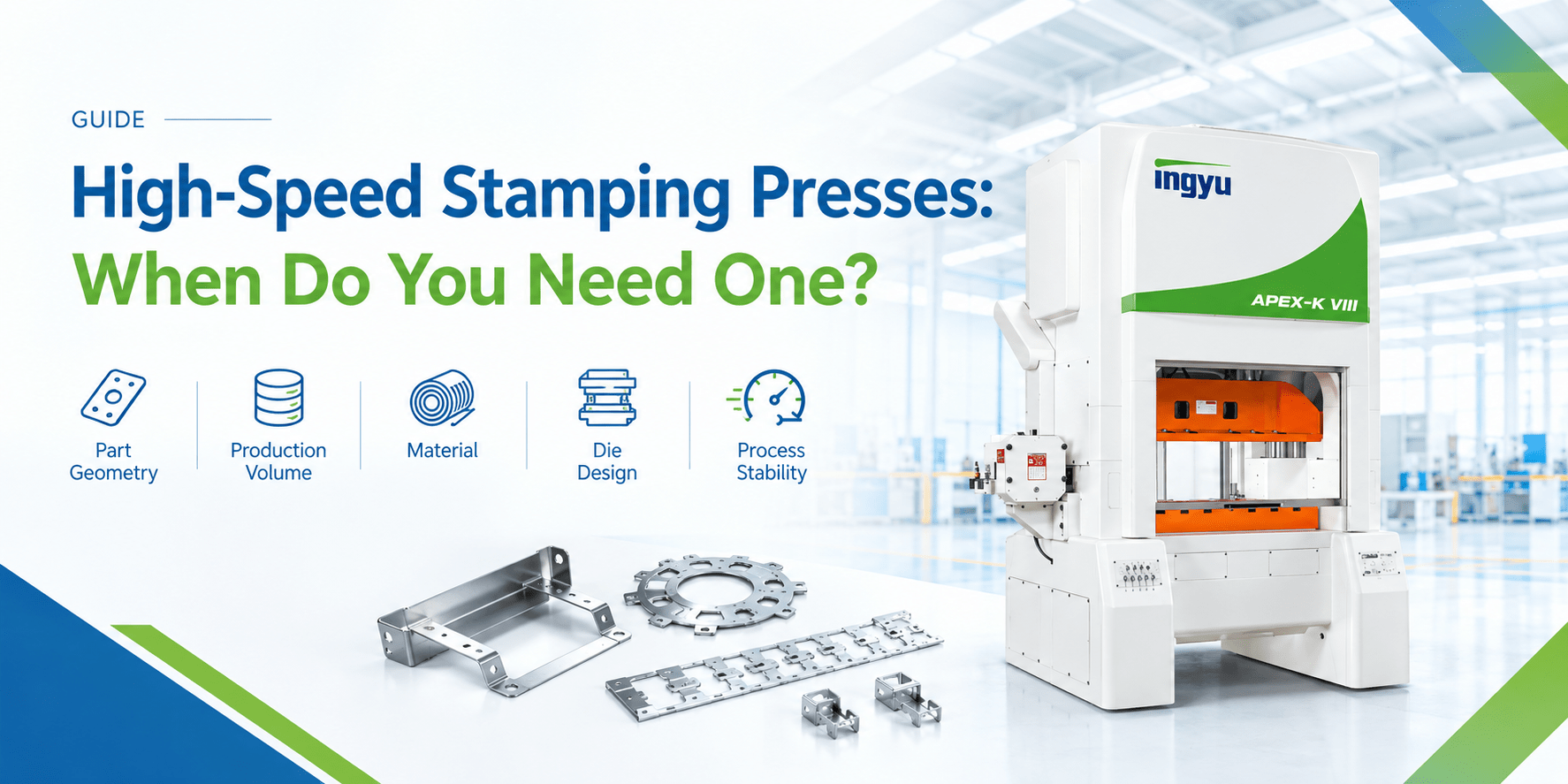
A high-speed stamping press can increase output within the same production footprint, but it is not the right machine for every job. Whether you need one depends on your part geometry, production volume, material, die design and the stability of the process at speed.
This guide explains what defines a high-speed stamping press, when it makes sense to use one, when another press may be a better fit, and how to estimate potential output before investing.
1. What Counts as a High-Speed Stamping Press?
There is no single SPM (strokes per minute) threshold that defines every high-speed stamping press. Achievable speed depends on factors such as press capacity, stroke length, slide motion, die design, material and the feeding system. Smaller presses with shorter strokes can often run faster than larger presses, but maximum SPM alone is not enough to determine suitability.
A high-speed stamping press is a mechanical press designed to produce high volumes of components while maintaining repeatable performance at its intended operating speed. The relevant measures include dimensional consistency, burr control, die life and stable feeding—not speed alone. When comparing presses, evaluate SPM alongside rated capacity, stroke length, die and bed dimensions, material requirements, and the accuracy needed for the part.
The following ranges are from INGYU’s high-speed series. They illustrate how rated speed varies by press configuration; actual operating speed depends on the application, tooling and production-line setup:
Civic C-Frame High-Speed Press
- Capacity: 25–45 tons
- Stroke: 30 mm
- Speed: 800–1,000 SPM

Apex Straight-Side High-Speed Press
- Capacity: 45–125 tons
- Stroke: 30 mm
- Speed: 500–900 SPM

HV Multi-Point High-Speed Press
- Capacity: 350 tons
- Stroke: 30 mm
- Speed: 150–500 SPM

2. Five Signs You Need a High-Speed Press
- You run high, stable volumes of the same part
A high-speed press is most likely to deliver value when the same part runs for long periods with few changeovers. For products such as terminals, motor laminations and can ends, higher output spreads labor, setup and overhead costs across more parts.
- Your parts are small and your material is thin
High-speed presses are often used for small, precise components made from thin strip. For example, motor laminations may use electrical steel below 0.5 mm thick. Thin materials make burr control and dimensional consistency especially important, which is exactly what a high-speed precision press is designed to deliver.
- You use progressive dies fed from coil
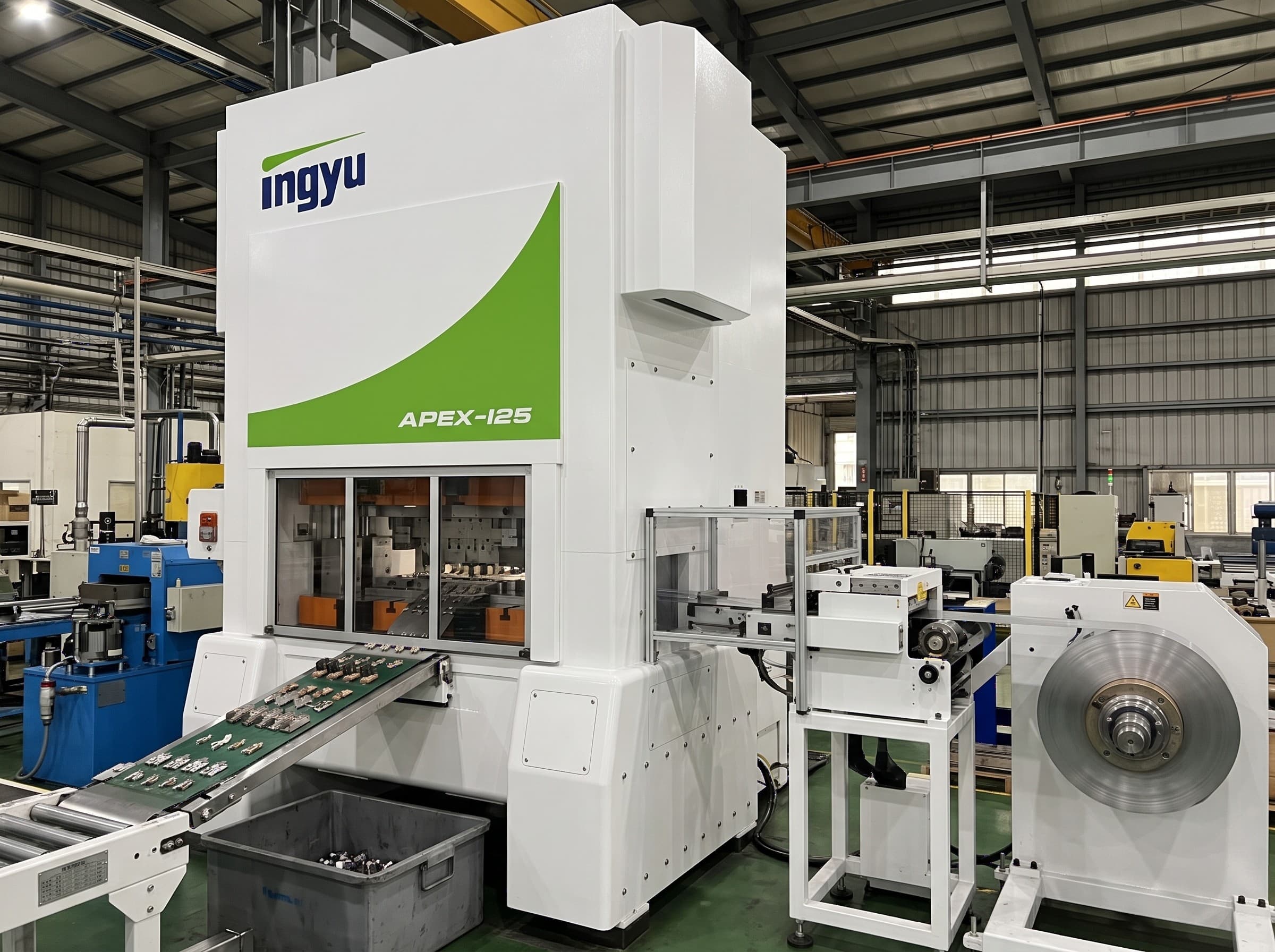
A coil-fed progressive die performs multiple operations at successive stations as the strip advances. Once the die is fully engaged in production, each press stroke can produce one or more finished parts, depending on the die layout. The number of stations does not necessarily equal the number of finished parts per stroke. High-speed operation therefore depends on matching the press, die, feed pitch, strip handling and scrap discharge.
- Cost per part decides whether you win the order
In high-volume markets such as consumer electronics, household appliances, automotive parts, and motor stators and rotors, small differences in cycle time, scrap rate and tooling costs can have a meaningful impact on total cost per part. A higher stroke rate is one of the most direct ways to lower unit cost, as long as quality and uptime hold.
- Your current press loses accuracy when you push it
If dimensional variation, increased burrs or accelerated die wear appear as speed rises, review the press, die, material, lubrication and feeding system together. If these symptoms persist after the die and feeding system are checked, the current press likely cannot sustain the target SPM, and a press designed for that speed is worth evaluating.
3. When a High-Speed Press Is Not the Right Choice
A high-speed press is a specialist. In these situations, a different press usually serves you better:
- High-mix, low-volume production: If you change dies several times a shift, setup time limits your output more than stroke rate does.
- Deep drawing and long-stroke parts: Battery cans and cups may require longer strokes and double-action forming. INGYU’s double-action cupping press raises output by forming multiple cups per stroke—up to 17, depending on part size and tooling—rather than by running faster.
- Thick material and heavy forming: Parts that require high force over a substantial portion of the stroke may need a press with a suitable energy profile, longer stroke and frame sized for the load. Check the press capacity curve and application requirements rather than choosing by nominal tonnage alone.
Choosing a press that matches the process helps avoid paying for speed that cannot be used. If your application falls between these categories, review the part drawing, material, die concept and target output with the press manufacturer.
4. Quick Math: Estimating Your Output Gain
Start with a simple estimate, then adjust it for the actual number of parts produced per stroke, scheduled production time, uptime and yield:
Estimated good parts per shift = SPM × Parts per stroke × Production minutes per shift × Uptime × Yield
For example, assume one finished part per stroke, an 8-hour shift (480 minutes), 85% uptime and 98% yield:
| Press | Speed | Estimated Good Parts per Shift |
|---|---|---|
| Conventional press | 200 SPM | 79,968 |
| High-speed press | 600 SPM | 239,904 |
This illustrative calculation assumes the same part, die, uptime and yield at both speeds; it is not a production guarantee. Actual output depends on the validated operating speed, die design, material, feeding reliability, changeovers and downtime.
Two practical points affect the result:
- Shorter stroke, potentially higher speed: Stroke length and SPM both affect slide motion. A shorter stroke may allow a higher rated speed when the application permits it; check the permitted speed-and-stroke combinations in the press specifications.
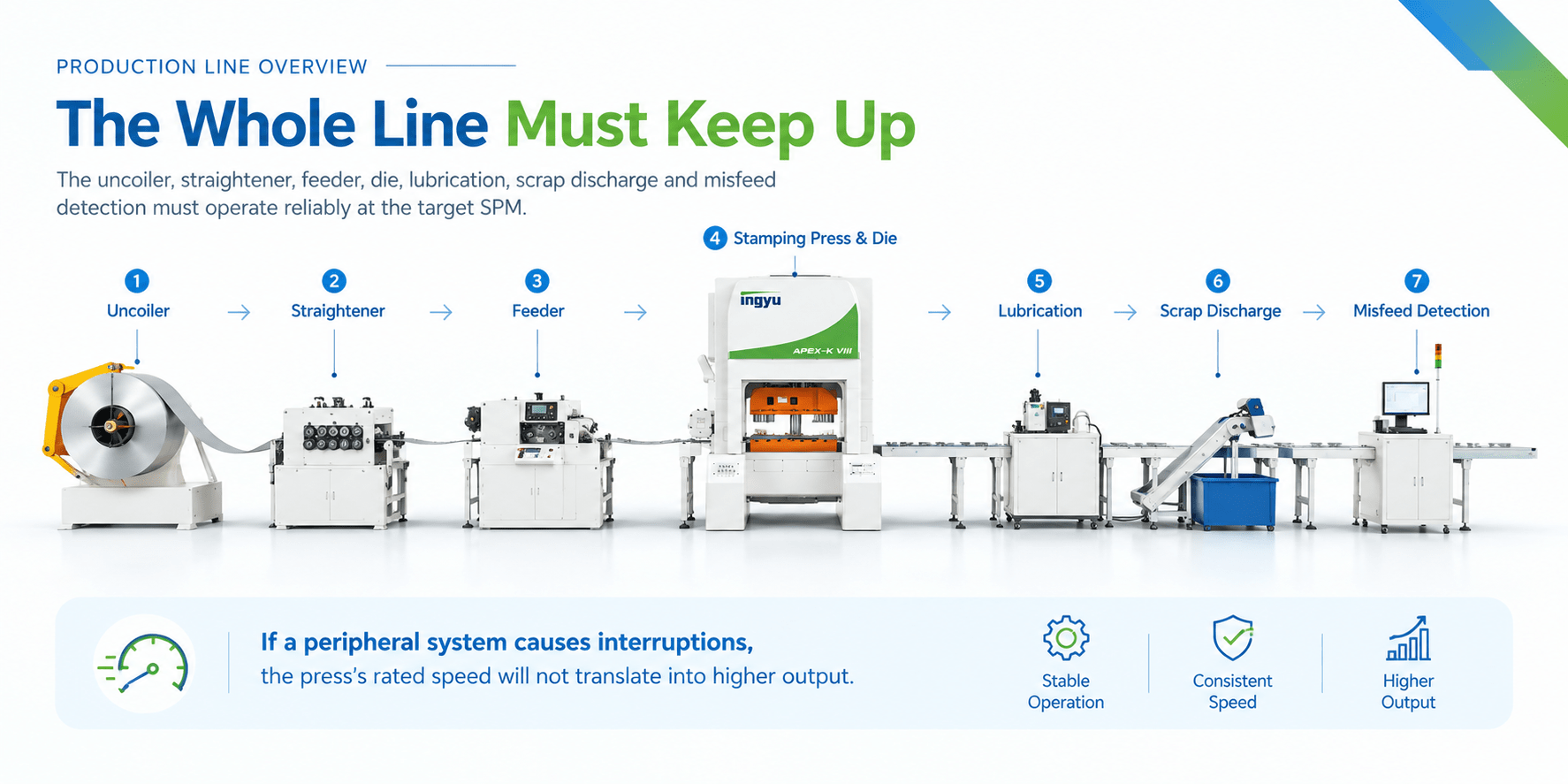
- The whole line must keep up: The uncoiler, straightener, feeder, die, lubrication, scrap discharge and misfeed detection must operate reliably at the target SPM. If a peripheral system causes interruptions, the press’s rated speed will not translate into higher output.
5. What Makes a Press Machine Truly High-Speed
A high-speed press is not simply a conventional press running a faster motor. At the target operating speed, the machine must maintain the motion and alignment required by the die and part. Frame rigidity, guiding accuracy, thermal behavior and bottom-dead-center repeatability all affect stamping consistency.
| Design Feature | Why It Matters at High Speed | How INGYU Builds It |
|---|---|---|
| Frame Rigidity | Less deflection under load helps keep die clearance consistent and reduces burrs. | • Apex presses use a two-piece cast frame. • HV multi-point presses keep bed deflection within 0.05 mm/m. • Civic C-frame presses add a gap enclosure to reduce deformation. |
| Guiding Accuracy | A straight slide path lets punches enter the die squarely. | Guide post bushings are built into the bottom frame for high vertical accuracy. |
| Thermal Control | Heat at speed expands components and shifts bottom dead center. | Thermal control systems support stable 24/7 production. |
| Bottom-Dead-Center Stability | Consistent bottom dead center supports consistent dimensions and longer die life. | Stable bottom dead center is a core design goal across INGYU high-speed presses. |
| Precision Assembly | A tight fit between mating surfaces helps keep the machine stable over years of use. | Mating surfaces are hand-scraped during assembly. |
For a deeper look at how rigidity, bottom-dead-center stability and thermal behavior affect precision stamping, see our selection guide for electronic connector presses.
6. Matching INGYU High-Speed Presses to Your Application
| Application | Typical Parts | Recommended Press |
|---|---|---|
| Electronic Connectors | Terminals and connectors for consumer, automotive and industrial electronics | • Civic C-frame (25–45 tons) for small dies • Apex straight-side (45–125 tons) for longer progressive dies |
| Motor Laminations | Stator and rotor cores for EV and industrial motors | • Apex-125 for standard cores • HV350 multi-point (350 tons) for thin material and long dies |
For lead frames, can ends and other applications, see our full range of stamping solutions.
7. Frequently Asked Questions
- How fast is a high-speed stamping press?
Speed depends on press size and configuration. INGYU’s high-speed presses range from up to 1,000 SPM on 25-ton C-frame models to 150–500 SPM on 350-ton multi-point models. Lower tonnage and shorter strokes generally allow higher speeds.
- Can I just run my conventional press faster?
Increasing the speed of a conventional press may introduce more vibration, heat or variation in bottom-dead-center position, depending on its design and condition. If quality changes as speed rises, assess the press together with the die, material, lubrication and feeding system before deciding whether a different press is needed.
- Is a high-speed press harder to maintain?
Higher stroke rates place greater demands on lubrication, dies and peripheral equipment, so preventive maintenance and monitoring are important. How much maintenance a press needs depends on its design, operating conditions and maintenance practices.
- Are high-speed presses only for electronics?
No. Besides electronics, they are widely used for household appliance parts, automotive parts, and motor stators and rotors.
Not Sure Whether You Need a High-Speed Press?
Send us your part drawing, material type and thickness, target annual output, and—if available—die layout and required tolerances. INGYU’s engineers can review the application and recommend a suitable press configuration, whether that is a high-speed model or another press type.
Contact INGYU for an application review, or explore our stamping solutions.
BACK